
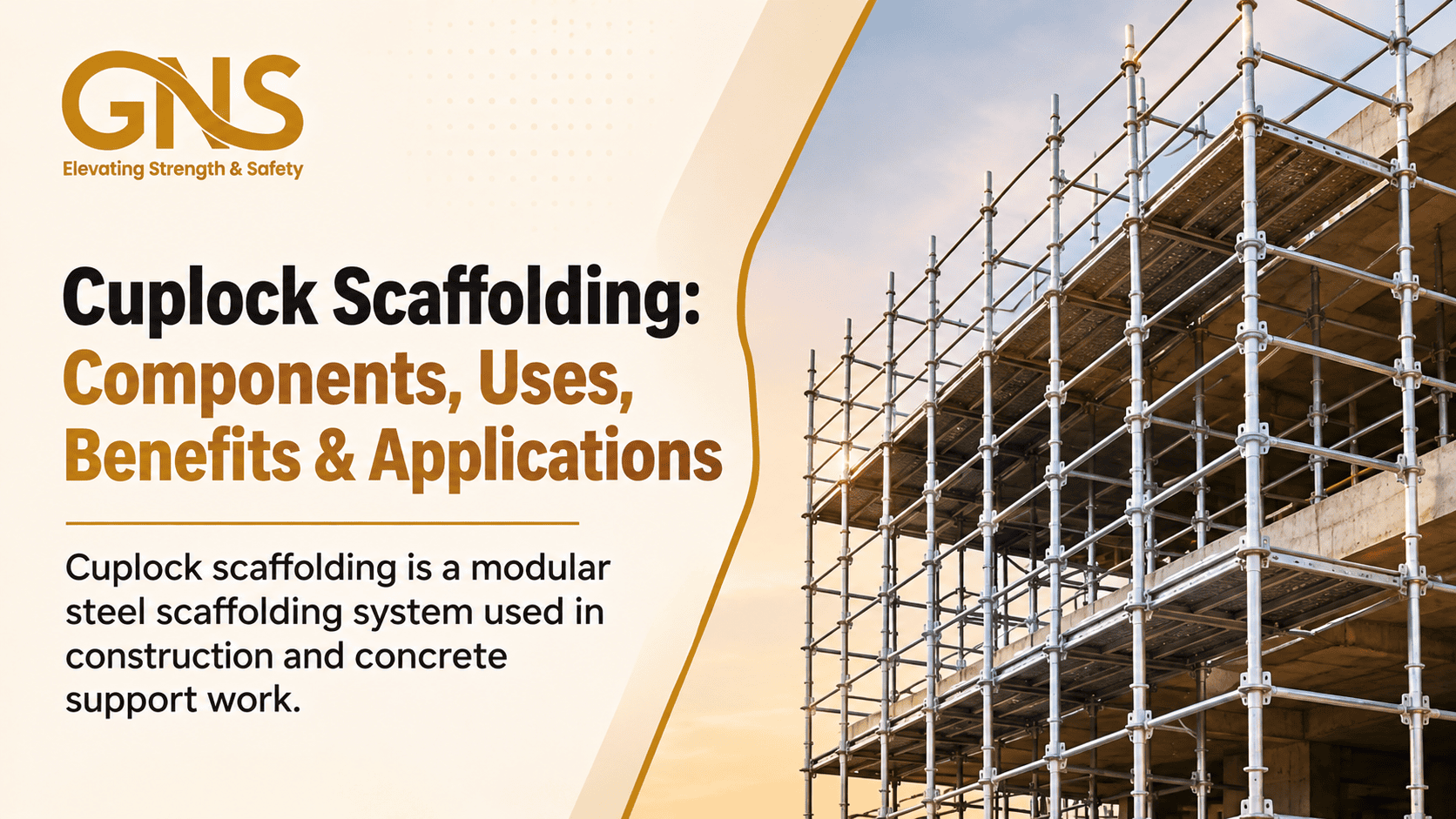
Cuplock scaffolding provides a modular steel framework for construction, concrete support work, building maintenance, and projects that require temporary access or structural support. Its cup-and-blade connection system allows workers to connect horizontal members to vertical standards through locking cups, making it suitable for projects that require organized, adaptable scaffolding arrangements.
Contractors, builders, and project managers must understand how cuplock scaffolding works before selecting a system for rental or purchase. The right setup depends on the project structure, working height, load requirements, site conditions, access needs, and duration of work.
This guide explains cuplock scaffolding components, its working mechanism, applications, advantages, rental considerations, and essential safety factors.
Quick Answer: What Is Cuplock Scaffolding?
Cuplock scaffolding is a modular scaffolding system that connects horizontal ledgers to vertical standards through a cup-based locking mechanism. Workers can assemble the system into different configurations to create construction access, concrete support structures, maintenance platforms, and other temporary working arrangements.
Contractors commonly consider cuplock scaffolding for:
- Building construction and façade work
- Slab and beam support applications
- Bridge and infrastructure projects
- Industrial maintenance
- Large working platforms
- Temporary access structures
The project requirements and engineering specifications determine whether cuplock scaffolding suits a particular application.
Key Takeaways
- Cuplock scaffolding uses vertical standards, horizontal ledgers, and cup connections to create a modular structure.
- Its cup connection allows workers to connect multiple horizontal members at a node.
- Contractors may require additional components such as diagonal braces, base jacks, platforms, and joint pins.
- The system supports different construction and temporary access applications.
- Rental can help contractors manage scaffolding requirements for a specific project duration.
- Component compatibility, structural design, installation quality, and inspection play critical roles in scaffolding safety.
- Contractors should select scaffolding according to project requirements rather than price alone.
What Is Cuplock Scaffolding?
Cuplock scaffolding is a modular steel scaffolding system that connects vertical and horizontal members through cup-type locking joints.
Conventional tube-and-coupler scaffolding requires separate couplers to connect tubes. Cuplock scaffolding integrates connection points into its vertical standards. Workers position ledger ends inside the lower cup and use the upper cup to secure the connection.
This modular arrangement helps contractors create repeated bays and working levels for temporary access and support structures.
Contractors often consider cuplock systems for projects that require a consistent scaffolding layout across large working areas.
How Does the Cuplock Scaffolding System Work?
The cuplock system connects horizontal ledger members to vertical standards through cup-and-blade connections.
Workers follow the basic connection process:
- Position the vertical standard to establish the connection point.
- Place the ledger blade inside the lower cup.
- Bring down the upper cup to secure the connection.
- Connect the required members according to the planned scaffold structure.
The system manufacturer provides the assembly and locking instructions, and the approved scaffolding design determines the configuration.
Because workers can connect multiple members at a node, the system supports different layouts for access scaffolds and temporary support structures.
What Are the Main Components of Cuplock Scaffolding?
A cuplock scaffolding structure combines several components to create a stable framework. Contractors must select each component according to the required configuration and project specifications.
1. Cuplock Standards (Verticals)
Standards form the vertical members of the scaffolding system.
They create the main vertical framework and contain cup connection points at specified intervals. Workers connect standards to the supporting base arrangement and extend them using compatible joining components where required.
Purpose: To form the vertical framework of the scaffolding structure.
2. Cuplock Ledgers (Horizontals)
Ledgers connect adjacent vertical standards horizontally.
Their blade ends fit into the cuplock connection points and create horizontal connections between standards. Ledgers help contractors define the bays and levels of the scaffolding arrangement.
Purpose: To connect standards horizontally and establish the scaffold layout.
3. Top Cups and Bottom Cups
Cup connections define the cuplock scaffolding system.
The lower cup receives the ledger blade, while the upper cup secures the connection. This arrangement allows workers to connect horizontal members at the node.
Purpose: To create the system's modular locking connection.
4. Diagonal Bracing
Diagonal braces help the scaffolding structure resist lateral movement and maintain stability when the approved design requires them.
The scaffold configuration, height, loading, site conditions, and design requirements determine the placement and quantity of diagonal braces.
Purpose: To provide structural stability to the scaffold.
5. Base Jacks
Base jacks help contractors adjust the scaffold base within the permitted adjustment range and establish the required base level.
Workers must use base jacks within their approved adjustment limits and place them on an appropriate foundation or base arrangement.
Purpose: To support base adjustment and leveling.
6. Joint Pins or Spigots
Joint pins or spigots connect compatible standards and help contractors extend vertical members.
The scaffolding system determines the type of joint pin and its locking arrangement.
Purpose: To connect compatible vertical standards.
7. Working Platforms or Walkways
Platforms provide a working surface for personnel and, where permitted, tools and materials.
Contractors must determine the platform arrangement, securing method, width, access, and loading requirements according to the intended scaffold configuration.
Purpose: To provide a working surface within the scaffold structure.
8. U-Head Jacks
Contractors may use U-head jacks in scaffolding or support arrangements when the design requires a head component to accommodate or support formwork members.
Purpose: To provide an adjustable head support for compatible structural arrangements.
Not every project requires all these components. Contractors should prepare the actual material requirement according to the approved layout and project specifications.
What Are the Applications of Cuplock Scaffolding?
Contractors use cuplock scaffolding across construction and industrial projects when the configuration and approved design support the intended application.
| Application | Typical Purpose |
|---|---|
| Building construction | Access to different levels of construction work |
| Slab support | Temporary support arrangements for concrete slab work |
| Beam support | Supporting formwork arrangements where designed |
| Bridge construction | Access or temporary support applications |
| Industrial maintenance | Access for inspection, maintenance, and repair |
| Façade work | External access for building work |
| Large working platforms | Creating access across defined working areas |
| Infrastructure projects | Temporary access or support arrangements |
Contractors must distinguish between access scaffolding and load-supporting scaffolding. A scaffold designed to provide worker access does not automatically qualify to support concrete formwork or other structural loads.
What Are the Benefits of Cuplock Scaffolding?
Contractors choose cuplock scaffolding when a modular system and organized connection arrangement support their project requirements.
Modular Configuration
Contractors can arrange the system into different bay layouts and working levels according to the project design.
Organized Connection Arrangement
Cup-based connections provide a defined method for connecting horizontal members to vertical standards.
Suitable for Repetitive Layouts
The modular system works well for projects that involve repeated bays, levels, or similar structural arrangements.
Reduced Reliance on Loose Couplers for Ledger Connections
The system integrates cup connections into its components, reducing the need for separate couplers at those ledger connection points.
Adaptability
Contractors can configure compatible cuplock systems for different access and support applications, depending on the system and design.
Rental Flexibility
Contractors can rent the required scaffolding to manage temporary equipment needs without necessarily purchasing the complete system.
These advantages do not replace proper design, inspection, installation, bracing, or safe working practices.
Cuplock Scaffolding vs. Other Scaffolding Systems
Different scaffolding systems serve different project requirements. Contractors should not assume that cuplock scaffolding offers the best solution for every construction project.
| Scaffolding System | Typical Characteristics | Common Consideration |
|---|---|---|
| Cuplock scaffolding | Modular cup connections between standards and ledgers | Useful for planned, repetitive layouts |
| MS pipe scaffolding | Steel tubes connected using separate fittings | Offers layout flexibility but requires proper connection assembly |
| Aluminium scaffolding | Lightweight components | Useful when handling weight and access requirements matter |
| Mobile scaffolding tower | Movable access tower with wheels, where designed for mobility | Suitable only for compatible work conditions and safe movement requirements |
| Frame scaffolding | Prefabricated frames connected into a structure | Often suitable for straightforward access layouts |
Contractors should evaluate working height, site geometry, loading, access, erection requirements, available equipment, and project duration before selecting a scaffolding system.
How to Choose the Right Cuplock Scaffolding for Your Project?
Before arranging cuplock scaffolding rental, contractors should assess their actual project requirements.
1. Identify the Type of Work
Determine whether the project requires scaffolding for:
- Building construction
- Slab or beam support
- Façade work
- Painting
- Maintenance
- Industrial work
- Renovation
The intended application will influence the system configuration.
2. Determine the Working Height
Identify the required access or support height and the number of working levels.
Working height affects the scaffold layout, bracing, access arrangements, erection planning, and structural design.
3. Evaluate Site Conditions
Inspect the ground or supporting surface, available space, access routes, obstructions, nearby structures, and material unloading area.
These conditions can influence material planning, transportation, erection, and the final scaffolding arrangement.
4. Understand Load Requirements
Consider the intended working loads, personnel, materials, equipment, and whether the structure will support formwork or other loads.
Qualified personnel should complete project-specific load calculations.
5. Plan Access and Working Platforms
Determine how workers will access each working level and what platform arrangement the project requires.
Include access, edge protection, and platform arrangements in the approved scaffold design.
6. Estimate Rental Duration
Estimate the total period for which the project will require scaffolding, including erection, working time, dismantling, and any possible extension.
7. Confirm Installation Requirements
Determine whether the project requires installation and dismantling support. Also, identify the parties responsible for scaffold erection, inspection, and supervision.
What Factors Affect Cuplock Scaffolding Rental Cost?
Cuplock scaffolding rental cost depends on material quantity, configuration, rental period, transportation, accessories, and project-specific requirements.
No single rental rate applies to every project.
| Cost Factor | How It Affects the Quotation |
|---|---|
| Scaffolding quantity | Determines the amount of material required |
| System configuration | Different layouts require different components |
| Rental duration | The rental period affects the total rental amount |
| Working height | May affect material requirements and installation planning |
| Transportation | Depends on delivery location, quantity, and logistics |
| Installation | Depends on the scope and complexity of erection |
| Dismantling | Depends on the dismantling scope and site conditions |
| Accessories | Platforms, braces, jacks, and connectors may add to the requirement |
| Site conditions | Access, ground conditions, and project constraints can affect planning |
To obtain an accurate quotation, share your project location, approximate height, intended application, rental duration, and available layout or drawing.
Why Consider Cuplock Scaffolding Rental Instead of Buying?
Renting cuplock scaffolding can help contractors manage temporary equipment requirements without committing to ownership.
Rental May Suit Your Project When:
- You need scaffolding for a defined project period.
- You require scaffolding for one specific site.
- You want to avoid purchasing and storing the complete system.
- Your material requirements change between projects.
- You want to arrange equipment according to individual project needs.
Buying May Suit Your Business When:
- You use scaffolding regularly across multiple projects.
- You have suitable storage facilities.
- You can manage equipment inspection, maintenance, and inventory.
- You regularly require the same scaffolding system.
Evaluate total project costs, equipment utilization, ownership expenses, storage, maintenance, and future requirements before deciding. Do not base the decision solely on the rental rate or purchase price.
What Safety Factors Should You Consider?
Contractors must erect, use, inspect, and dismantle cuplock scaffolding according to applicable safety requirements and the approved scaffold design.
Pay attention to these important safety considerations:
- Foundation and base support: Provide a suitable foundation and base arrangement for the scaffold.
- Vertical alignment: Install and maintain standards according to the approved configuration.
- Bracing: Install the required braces and ties according to the scaffold design.
- Connections: Check that workers use compatible components and connect them correctly.
- Platforms: Install and secure working platforms properly and ensure they suit the intended use.
- Access: Provide appropriate access to working levels.
- Edge protection: Install required guardrails, toe boards, and other protection.
- Loading: Keep scaffold loading within approved limits.
- Inspection: Inspect scaffolding before use, after modifications, and after events that may affect stability.
- Competent supervision: Assign competent personnel to manage erection, modification, and dismantling.
Never modify a scaffold by adding, removing, or repositioning components without appropriate authorization and assessment.
Follow applicable regulations, competent-person guidance, approved designs, and manufacturer instructions when making safety-related decisions.
Cuplock Scaffolding Rental in Gurgaon, Delhi NCR and Noida
Construction and infrastructure projects across Gurgaon, Delhi, Noida, Faridabad, and other parts of Delhi NCR often require scaffolding at different stages of work.
Contractors may need to adjust their material and installation plans according to:
- Building type and height
- Construction or maintenance activity
- Site access and unloading conditions
- Available working space
- Rental duration
- Required access levels
- Erection and dismantling scope
Providing accurate project details during the enquiry helps scaffolding suppliers understand the requirement and prepare a more relevant quotation.
For projects in Gurgaon and Delhi NCR, confirm delivery arrangements, material availability, site access, installation requirements, and the expected rental schedule before finalizing the order.
How Does Guru Nanak Scaffoldings Support Cuplock Scaffolding Requirements?
Guru Nanak Scaffoldings provides scaffolding rental and related scaffolding services for construction and project requirements.
When your project requires cuplock scaffolding or another scaffolding arrangement, start the enquiry by sharing your site requirements, intended use, approximate working height, material quantity, rental duration, and installation scope.
Depending on the project, you may also need associated access equipment, support components, or other compatible materials.
Planning your construction, maintenance, or renovation requirements in advance can help you coordinate material planning, rental duration, delivery, and installation.
Frequently Asked Questions About Cuplock Scaffolding
1. What is cuplock scaffolding used for?
Contractors use cuplock scaffolding for temporary access and support arrangements in construction, infrastructure, maintenance, and other projects that require a modular scaffold structure.
2. What are the main components of cuplock scaffolding?
The main components include vertical standards, horizontal ledgers, cup connections, diagonal braces, base jacks, joint pins or spigots, and working platforms, depending on the system configuration.
3. Why do contractors call cuplock scaffolding a modular system?
Contractors call it modular because they connect its standards, ledgers, and compatible components in a planned arrangement to create different scaffold layouts and levels.
4. Is cuplock scaffolding suitable for slab construction?
Contractors may use cuplock systems for slab-support and formwork applications when the complete arrangement meets the design requirements for intended loads and conditions. Never assume that an access scaffold can support concrete.
5. Can contractors rent cuplock scaffolding?
Yes. Contractors can arrange cuplock scaffolding on a rental basis, depending on material availability, project requirements, location, rental duration, and service scope.
6. What is the difference between cuplock and MS pipe scaffolding?
Cuplock scaffolding uses integrated cup connections on vertical standards to connect horizontal ledgers. Conventional MS pipe scaffolding commonly uses separate couplers to connect tubes. The project layout, application, site conditions, and design determine which system suits the requirement.
7. What determines cuplock scaffolding rental cost?
The quotation depends on material quantity, system configuration, rental duration, location, transportation, installation, dismantling, accessories, and site requirements.
8. Does cuplock scaffolding require diagonal bracing?
The scaffold configuration, design, height, loads, and site conditions determine the bracing requirements. Contractors must install the required bracing and ties according to the approved design.
9. Can contractors use cuplock scaffolding for industrial maintenance?
Yes, contractors may use cuplock scaffolding for industrial maintenance when they design the access structure to meet the work requirements, site conditions, loading, and safety requirements.
Conclusion
Cuplock scaffolding offers a modular solution for construction access, temporary support, maintenance, and other scaffolding applications. Its cup-based connection arrangement helps contractors create organized and repetitive scaffold layouts.
However, contractors must consider more than the scaffolding type when selecting a system. Working height, load requirements, site conditions, access, rental duration, installation, dismantling, and safety requirements all influence the final decision.
By evaluating these factors before arranging scaffolding rental, contractors and project managers can improve material planning, reduce avoidable delays, and select a system that better meets their project requirements.
Need Cuplock Scaffolding for Your Project?
If you need scaffolding for a construction, industrial, maintenance, or renovation project, share your project location, approximate working height, required application, material quantity, and expected rental duration with Guru Nanak Scaffoldings.
Discuss your scaffolding requirements and request a quotation for your project.
Guru Nanak Scaffoldings
Best Company for Scaffolding Rental | Supply | Installation & Dismantling
Website: https://www.gnscaffoldings.com/
Scaffolding Rental Services: https://www.gnscaffoldings.com/new-services/scaffolding-rental-service/
Phone: +91-9506123555