
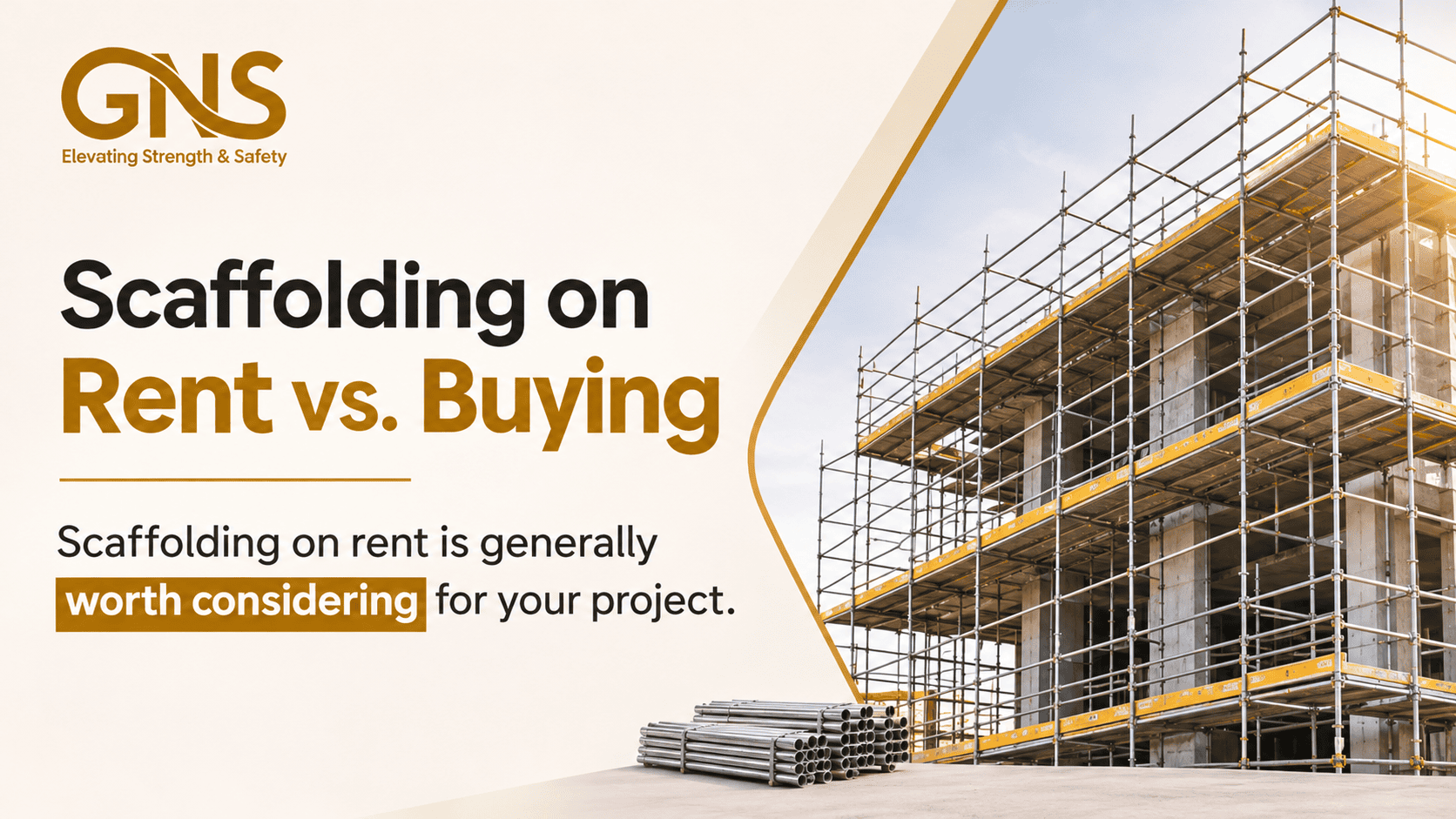
Choosing between scaffolding on rent and buying scaffolding depends on your project duration, budget, equipment requirements, storage capacity and expected future use. For contractors handling short-term construction, maintenance or renovation projects, renting can reduce the initial investment and the responsibility of storing equipment after work is completed. Buying may be more economical for businesses that use compatible scaffolding equipment continuously across multiple projects over an extended period.
For construction projects in Gurgaon, Delhi, Noida and Faridabad, the right decision should be based on the total cost of using scaffolding, not just the rental charge or purchase price. Transportation, erection, dismantling, maintenance, storage, equipment availability and resale value can all affect the final cost. This guide explains both options so builders, contractors, developers and site engineers can make an informed decision.
Quick Answer: Is It Better to Rent or Buy Scaffolding?
Scaffolding on rent is generally worth considering for short-term, one-off or uncertain projects. Buying may suit contractors with frequent, predictable demand and the capacity to maintain, inspect and store their equipment.
- Choose renting when you need scaffolding temporarily, want to limit upfront investment or have changing equipment requirements.
- Consider buying when you have regular demand, sufficient storage and a plan to reuse the equipment over many projects.
- Compare total costs rather than comparing rental charges with the purchase price alone.
- Prioritize safety and suitability regardless of whether the equipment is rented or owned.
Guru Nanak Scaffoldings provides scaffolding and shuttering rental solutions across Gurgaon and other Delhi NCR locations, including options such as cuplock scaffolding, mobile scaffolding, aluminium towers and shuttering materials.
Key Takeaways
- Renting reduces the initial capital commitment associated with purchasing scaffolding.
- Buying creates an asset but also brings storage, inspection, maintenance and inventory-management responsibilities.
- Project duration and equipment reuse are two of the most important decision factors.
- The right scaffolding system depends on the construction activity, working height, site conditions and project requirements.
- Delivery, collection, erection and dismantling charges should be checked before comparing quotations.
- A rental supplier's available inventory and delivery schedule can affect project planning.
- Both rented and purchased scaffolding require appropriate inspection, installation and safe use.
1. What Is Scaffolding Rental?
Scaffolding rental is a service through which construction companies, contractors and builders hire scaffolding equipment for a specified period instead of purchasing it permanently.
Depending on the project, rental equipment may include:
- Cuplock scaffolding systems
- MS pipes and bracing pipes
- Mobile scaffolding
- Aluminium towers and ladders
- Base jacks and adjustable jacks
- Shuttering plates, props, channels and related materials
Rental arrangements may also include delivery, site pickup, installation, dismantling and other support services, depending on the supplier and the agreed quotation.
For example, a contractor carrying out exterior finishing on a commercial building may need scaffolding for a limited period. Renting can provide access to the required equipment without requiring the contractor to purchase, store and maintain it permanently.
Guru Nanak Scaffoldings lists these types of equipment and rental options on its scaffolding rental service page.
2. What Does Buying Scaffolding Mean?
Buying scaffolding means purchasing equipment for your company's own use rather than returning it to a rental supplier after a project.
The purchased equipment becomes part of your business assets and can be reused across projects, provided it remains suitable and safe for use.
Buying may be worth considering if your company:
- Has several ongoing construction projects.
- Uses the same compatible scaffolding systems regularly.
- Has sufficient space for safe storage.
- Can manage equipment inspection, maintenance and inventory.
- Has the resources to transport and handle the equipment.
- Can plan future requirements with reasonable confidence.
However, ownership does not eliminate costs. Equipment may need repair or replacement, components can be lost or damaged, and unused materials can occupy valuable storage space.
Important: Owning scaffolding does not automatically make it cheaper. The financial benefit depends on utilization, operating costs, equipment life and resale value.
3. Scaffolding on Rent vs Buying: Comparison Table
The following table provides a practical starting point for comparing the two options.
| Decision factor | Scaffolding on rent | Buying scaffolding |
| Initial investment | Usually lower | Higher upfront investment |
| Project duration | Often suitable for short or variable periods | Can suit continuous, long-term use |
| Storage | Usually less equipment storage required by the customer | Customer needs suitable storage |
| Maintenance | Depends on the rental agreement and division of responsibilities | Owner manages maintenance and inspections |
| Equipment availability | Depends on supplier stock and delivery schedule | Depends on owned inventory |
| Changing requirements | May be easier to adjust through a rental supplier | Requires additional purchases or inventory planning |
| Reuse across projects | Equipment is returned after the rental period | Equipment can be reused across suitable projects |
| Transportation | Charges depend on the rental agreement | Owner arranges and pays for transport |
| Residual value | No asset resale value for the renter | Equipment may retain resale value |
| Management responsibility | Shared according to the contract | Greater direct inventory responsibility |
No single option is best for every construction business. Compare the actual commercial terms and the operational requirements of your project before making a decision.
4. What Are the Benefits of Scaffolding on Rent?
Lower upfront investment
Renting allows contractors to access equipment without paying the full purchase price at the beginning. This can help preserve cash for labour, materials, transportation and other project expenses.
Flexibility for different projects
One project may require cuplock scaffolding, while another may need mobile scaffolding or an aluminium tower. Renting allows you to discuss equipment requirements with a supplier for each job.
Reduced storage burden
After the rental period, equipment can be returned according to the agreement. This can be useful for contractors who do not operate a dedicated equipment yard.
Less ownership-related administration
Depending on the rental contract, the supplier may handle certain maintenance, inspection, repair or replacement responsibilities. Confirm exactly what is included instead of assuming every service is covered.
Easier planning for temporary requirements
Rental can be practical for painting, plastering, façade work, renovation, industrial maintenance and other activities that require temporary access.
Potentially better cash-flow management
A rental payment schedule may be easier to manage than a large equipment purchase. However, long rental periods and extensions can increase the total cost, so the contract duration must be planned carefully.
5. What Are the Benefits of Buying Scaffolding?
Buying can offer advantages when equipment demand is regular and the business has the resources to manage ownership.
Long-term reuse
A contractor undertaking multiple projects may be able to reuse compatible equipment rather than repeatedly paying rental charges.
Greater control over inventory
Owned equipment can be available when needed, subject to its condition, quantity, location and suitability for the project.
Potential long-term cost savings
If the equipment is used frequently over a long period, purchasing may become more economical than renting. This should be established through a cost comparison rather than assumed.
Potential resale value
Equipment in suitable condition may retain some resale value. The amount depends on its condition, age, demand, completeness and market conditions.
Suitable for predictable demand
Businesses with stable, recurring requirements can plan purchases around their equipment needs and project pipeline.
Direct responsibility for equipment planning
Ownership lets a business control how it allocates equipment among projects. However, it also needs a reliable system for tracking quantities, condition, repairs and missing components.
6. When Should You Rent Scaffolding Instead of Buying?
Renting is worth evaluating when the need for scaffolding is temporary, uncertain or likely to vary between projects.
Consider these examples:
| Project scenario | Option worth considering | Reason |
| Short-term building renovation | Renting | Equipment is needed for a limited period |
| Painting or plastering contract | Renting | Demand may end when the job is completed |
| One-off industrial maintenance | Renting | Purchasing equipment may be unnecessary |
| A new contractor with limited capital | Renting | Lower upfront commitment |
| Project with changing equipment needs | Renting | Requirements can be discussed with the supplier |
| Large project with a long but fixed duration | Compare both | Total rental cost may become substantial |
| Several ongoing projects using the same system | Buying or a hybrid approach | Equipment may be reused frequently |
| Regular, predictable construction work | Compare ownership economics | High utilization can improve the case for buying |
These are general decision guidelines, not fixed rules. For example, even a long-term project can justify renting if purchasing, storing and managing equipment would cost more.
7. When Does Buying Scaffolding Make More Sense?
Buying deserves serious consideration when your company uses the same type of scaffolding regularly and can keep the equipment productively deployed.
Before purchasing, evaluate the following:
- Annual usage: How many months each year will the equipment actually be in use?
- Project pipeline: Do you have confirmed or reasonably predictable future projects?
- Equipment compatibility: Can the equipment be reused across the types of work you undertake?
- Storage capacity: Can the components be stored and organized appropriately?
- Maintenance resources: Can your team manage inspection, repair and replacement?
- Transportation: Can you move the equipment economically between sites?
- Capital availability: Will the purchase affect cash flow or other project commitments?
- Resale prospects: Is there a realistic market for the equipment when it is no longer needed?
If demand is uncertain, buying a large quantity of equipment may leave capital tied up in underused inventory.
8. How Do You Calculate Whether Renting or Buying Is Cheaper?
This is one of the most important parts of the decision.
Do not compare the total rental payment with the purchase price alone. Compare the full cost of using equivalent equipment for the same period and project requirements.
Cost of renting scaffolding
A practical estimate is:
Total rental cost =
Rental charges for the full period
- delivery and collection
- erection and dismantling
- additional accessories or services
- applicable extension, damage or loss charges
Include only the charges that apply under your supplier's quotation and agreement. Some services may already be included.
Cost of buying scaffolding
A practical estimate is:
Total ownership cost =
Purchase price
- transportation
- storage
- maintenance and inspection
- repair and replacement
- inventory handling − estimated resale value
Where relevant, also account for financing costs, insurance and the cost of capital.
9. What Hidden Costs Should You Check Before Renting or Buying?
The cheapest initial quote is not always the cheapest overall option. Before making a decision, ask for a complete breakdown of the costs.
If you rent scaffolding
Check whether the quotation includes:
- Transportation to and from the site.
- Loading and unloading.
- Erection and dismantling.
- Accessories and components.
- Minimum rental duration.
- Billing frequency and payment terms.
- Charges for extending the rental period.
- Responsibility for damaged or missing components.
- Inspection, maintenance and replacement arrangements.
- Conditions for returning the equipment.
If you buy scaffolding
Calculate the cost of:
- Purchasing the required quantity.
- Transporting equipment between projects.
- Storage and inventory management.
- Inspection, repairs and maintenance.
- Replacing damaged, missing or unsuitable components.
- Financing the purchase.
- Managing equipment that remains unused.
- Selling the equipment when it is no longer required.
The comparison should use the same equipment specifications and include equivalent services wherever possible.
10. Which Scaffolding Type Should You Rent or Buy?
The decision also depends on the type of equipment required.
Cuplock scaffolding
Often considered for building construction, industrial work and infrastructure projects. Renting may be practical for occasional projects, while frequent use across multiple suitable sites may justify evaluating ownership.
Mobile scaffolding
Useful for suitable maintenance, painting and interior work where movement between work areas is needed. Consider renting when the requirement is temporary or intermittent.
Aluminium scaffolding towers
Their relatively lightweight construction can make them suitable for certain maintenance and access applications. Check the working height, configuration, load limits and intended use before selecting a system.
MS pipes and bracing components
Contractors with recurring requirements may compare the economics of owning frequently used components with renting for specific projects. Compatibility, condition and proper inspection remain essential.
These are general selection considerations, not engineering recommendations for a particular site. A competent person should assess the required configuration and safe working conditions.
11. How Can Contractors in Delhi NCR Choose the Right Option?
For projects in Gurgaon, Delhi, Noida and Faridabad, consider the following factors before finalizing your decision.
Project duration and deadlines
Estimate how long the equipment will actually be needed, including potential delays. A project scheduled for two months may require a longer rental period if finishing work or handover is delayed.
Site access and logistics
Consider vehicle access, unloading space, storage limitations and the time required to move equipment between locations. Confirm delivery and collection arrangements with the supplier.
Equipment availability
If you rent, confirm that the required quantity and type are available for your project dates. Do not assume that all equipment will be available at short notice.
Installation and dismantling requirements
Determine who will erect, inspect and dismantle the scaffolding. Include the relevant service costs and responsibilities in your comparison.
Future project pipeline
If you expect recurring work across several construction sites, calculate how much time the equipment would remain in productive use. Buying becomes more attractive when utilization is consistently high.
Cash flow
A purchase can tie up funds that might otherwise support labour, materials and project operations. Renting spreads the expense over the agreed period, although the total cost may increase for extended projects.
Supplier support
Evaluate equipment condition, documentation, communication, delivery commitments and the clarity of the contract—not just the quoted price.
12. Scaffolding Safety: What Should You Check?
Safety should not be compromised to reduce rental or ownership costs.
Whether scaffolding is rented or purchased, ensure that:
- Equipment is appropriate for the intended application.
- Components are inspected for damage, deformation, corrosion and missing parts.
- The foundation and supporting surface are suitable.
- The structure is erected, altered and dismantled by competent personnel.
- Required bracing, access, guardrails and working platforms are provided as applicable.
- Load limits and project-specific design requirements are assessed.
- Inspections take place at appropriate intervals and after events that could affect stability.
- Damaged or unsuitable components are removed from service.
Scaffolding selection and erection should follow applicable safety requirements, manufacturer instructions and competent professional assessment. Do not assume that rented equipment is automatically safe simply because it comes from a supplier.
13. Why Consider Guru Nanak Scaffoldings for Scaffolding Rental?
When comparing rental suppliers, look for equipment options that match your requirements, transparent quotation terms and a clear plan for delivery and collection.
Guru Nanak Scaffoldings lists scaffolding and shuttering rental services for construction, commercial, industrial and infrastructure projects across Gurgaon and Delhi NCR. Its published service range includes cuplock scaffolding, mobile scaffolding, aluminium towers, MS pipes, adjustable jacks and shuttering materials.
The company also describes delivery, pickup, rental-period support and installation and dismantling options on its service page. Confirm availability, charges, scheduling and the scope of work directly before placing an order.
Explore the company's scaffolding rental services to discuss the equipment required for your project.
14. What Information Should You Share When Requesting a Scaffolding Quote?
To help a supplier prepare a relevant quotation, share:
- Project location.
- Type of construction or maintenance work.
- Required scaffolding system, if known.
- Approximate working height and required quantity.
- Expected rental duration.
- Whether delivery and collection are required.
- Whether erection and dismantling services are needed.
- Expected start date.
- Site access limitations or special requirements.
If you are unsure which system is suitable, explain the work to be performed and ask the supplier to clarify the available options. The final configuration should be assessed against the project's technical and safety requirements.
Frequently Asked Questions About Scaffolding on Rent vs Buying
1. Is Scaffolding on rent cheaper than buying?
Renting often requires less upfront investment and may be more economical for temporary projects. Buying can become more economical when equipment is reused frequently. Compare the total cost over the same period before deciding.
2. When should a contractor buy scaffolding instead of renting?
Buying may be suitable when the contractor has recurring equipment requirements, predictable projects, adequate storage and the resources to manage inspection, maintenance and transportation.
3. What factors affect scaffolding rental cost?
Rental cost can depend on equipment type, quantity, rental duration, project location, transportation, accessories, erection, dismantling and site requirements. Request an itemized quotation for an accurate comparison.
4. Can I rent scaffolding for a short-term construction project?
Yes. Rental arrangements may be available for short-term projects, depending on supplier terms, equipment availability and minimum rental periods. Confirm these details before booking.
5. Is scaffolding installation included in the rental price?
Not necessarily. Some quotations include installation and dismantling, while others charge for them separately. Ask the supplier to confirm the complete service scope.
6. Which scaffolding system is suitable for building construction?
The appropriate system depends on working height, structural configuration, access, loads, site conditions and the nature of the work. Cuplock and other compatible scaffolding systems may be considered following a project-specific assessment.
7. Is buying scaffolding a good investment for contractors?
It can be, particularly when the equipment is used consistently across multiple projects. Contractors should account for purchase cost, maintenance, storage, transport, utilization and expected resale value.
8. Can I rent scaffolding in Gurgaon and Delhi NCR?
Guru Nanak Scaffoldings lists rental services across Gurgaon, Delhi, Noida, Faridabad and other nearby locations. Confirm availability, delivery timelines and charges for your particular site.
Guru Nanak Scaffoldings
9. What happens if a rental project takes longer than expected?
Additional rental charges may apply according to the contract. Discuss extension terms with the supplier as early as possible and include a reasonable schedule contingency in your budget.
10. What should I compare before choosing a scaffolding supplier?
Compare equipment suitability and condition, availability, delivery, rental terms, installation services, maintenance responsibilities, collection arrangements and the total quoted cost.
11. Can a company use both rented and purchased scaffolding?
Yes. A hybrid approach can be useful: own regularly used equipment and rent additional or specialized systems when demand increases. The economics depend on utilization, compatibility and the costs of each arrangement.
12. How can I request a scaffolding rental quotation from Guru Nanak Scaffoldings?
Visit the scaffolding rental service page and contact the company with your project location, required equipment, estimated quantity, duration and installation requirements.
Conclusion: Should You Rent or Buy Scaffolding?
The decision between scaffolding on rent and buying scaffolding depends on how frequently you use the equipment, how long you need it, and the total cost of ownership or rental.
Renting is worth considering for temporary projects, changing equipment requirements and businesses that want to limit upfront investment. Buying deserves consideration when demand is consistent, equipment can be reused regularly and the business can manage storage, maintenance and transportation.
For contractors and builders in Gurgaon, Delhi, Noida and Faridabad, the best decision is the one that balances cost, availability, project timelines and safety.
Before committing, compare a rental quotation against the complete ownership cost for equivalent equipment.
Need Scaffolding for Your Construction Project?
Guru Nanak Scaffoldings offers scaffolding and shuttering rental solutions for construction and related projects across Delhi NCR. Discuss your project requirements with the team to identify available equipment and the relevant rental and service terms.
Request a Scaffolding Rental Quote
Share your project details to help the team understand your requirements.
Website: Scaffolding Rental Services
Phone: +91 9506123555